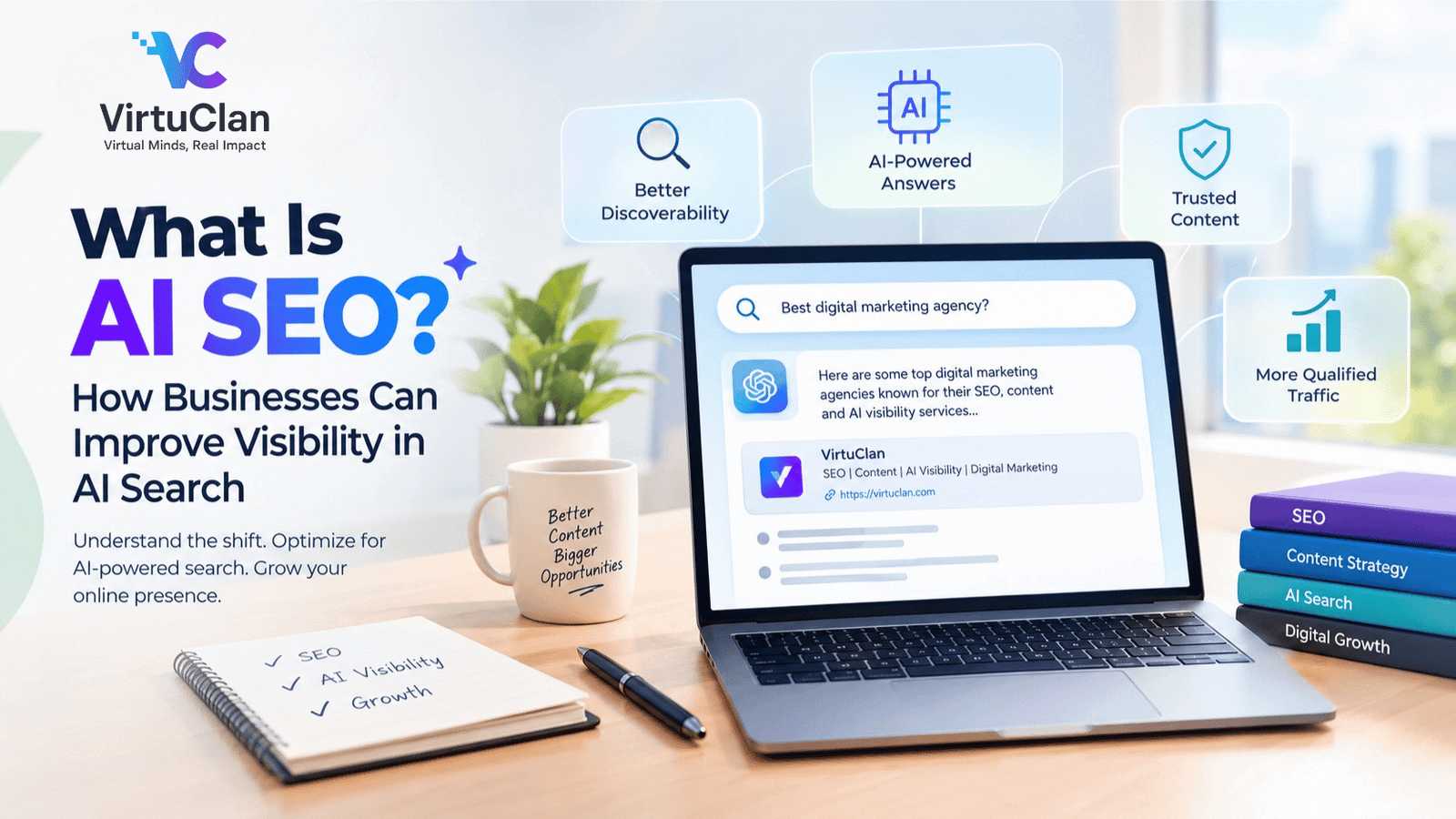
Search is changing. People are no longer relying only on traditional search results to discover brands, compare services, and make buying decisions. They are also asking AI-powered tools for recommendations, explanations, and direct answers.
This shift creates a new opportunity for businesses: being visible where people search, ask questions, and evaluate their options.
AI SEO helps businesses prepare their websites and content for this evolving search experience. It combines strong SEO fundamentals with clear, useful, trustworthy content that search engines and AI-powered systems can understand and potentially reference.
In this guide, we’ll explain what AI SEO is, how it differs from traditional SEO, and what businesses can do to strengthen their visibility across search and AI-driven discovery.
What Is AI SEO?
AI SEO is the practice of improving a website’s discoverability, content clarity, and relevance across search experiences that use artificial intelligence.
Traditional SEO focuses on helping web pages become discoverable and rank in search engine results. AI SEO builds on those fundamentals while considering how AI-powered search experiences interpret questions, gather information, and present answers.
Depending on the platform, these experiences may include summaries, recommendations, linked sources, or citations to relevant web pages.
AI SEO is not a replacement for traditional SEO. It is an extension of a strong search strategy into a changing digital landscape.
Why Is AI SEO Important for Businesses?
Your potential customers may search for a service in several ways. They might enter a short keyword, ask a detailed question, compare providers, or request a recommendation from an AI assistant.
If your website clearly explains what you do, who you help, how your service works, and why your business is credible, it becomes easier for people—and potentially search systems—to understand your expertise.
AI SEO can help businesses work toward:
-
Greater discoverability across evolving search experiences.
-
Clearer explanations of products, services, and areas of expertise.
-
Stronger topical relevance through useful, connected content.
-
Better opportunities to be considered as a relevant source.
-
More qualified website visitors and potential leads.
However, visibility in AI-generated answers is not guaranteed. It depends on the platform, the query, the available sources, and many other factors.
AI SEO vs. Traditional SEO: What Is the Difference?
Traditional SEO and AI SEO share the same foundation: helping people find useful, relevant information.
Traditional SEO commonly emphasizes organic rankings, keyword relevance, technical accessibility, internal linking, backlinks, and search-result performance.
AI SEO builds on those elements and also considers how clearly content answers natural-language questions, how well topics are explained, how claims are supported, and whether a page provides useful context that an AI-powered search experience may draw upon.
For example, a page targeting “digital marketing agency” should still have a useful title, strong technical foundations, and relevant content. It can also answer practical questions such as which services are offered, what types of businesses the agency serves, and how to get started.
The goal is not to write for machines instead of people. It is to make valuable information easy to discover, understand, and verify.
7 Practical Ways to Improve Your AI SEO
1. Build Content Around Real Customer Questions
Start with the questions your audience actually asks before choosing a product or service.
For a digital marketing agency, these questions might include:
-
What does an SEO agency do?
-
How can a business improve its visibility in AI search?
-
What is the difference between SEO and AI SEO?
-
How long does SEO take to produce results?
-
How can local businesses attract more qualified leads?
Create genuinely helpful pages that answer these questions directly. Explain the context, provide practical steps, and address common follow-up questions instead of repeating keywords without adding value.
2. Make Your Content Clear and Easy to Understand
Organize each page around one primary topic. Use descriptive headings, concise paragraphs, meaningful examples, and lists where they improve readability.
Define technical terms before using them extensively. Avoid vague claims and unnecessary jargon.
A well-structured article helps readers navigate the information and gives search systems clearer signals about the page’s subject.
3. Strengthen Your Technical SEO Foundation
Content cannot perform well if search engines struggle to access or understand the website.
Review important technical elements, including:
-
Crawlability and indexability.
-
XML sitemap availability and accuracy.
-
A properly configured robots.txt file.
-
Canonical tags and redirect handling.
-
Mobile usability and page performance.
-
Descriptive page titles and meta descriptions.
-
Appropriate structured data where relevant.
Use Google Search Console and Bing Webmaster Tools to monitor indexing, crawl issues, and search performance. Fix technical problems before investing heavily in publishing more content.
4. Demonstrate Experience, Expertise, and Trust
Give readers reasons to trust what your website says.
Publish content that reflects real knowledge, explain recommendations with useful reasoning, and identify authors or reviewers where appropriate. Support factual claims with reliable sources and keep important information up to date.
For service businesses, useful trust signals can include detailed service pages, genuine case studies, clear business information, relevant testimonials, and transparent contact details.
Never invent client results, credentials, reviews, or statistics to make content appear more authoritative.
5. Build Topic Clusters and Meaningful Internal Links
A single article rarely answers every question a potential customer may have.
Build a connected library of relevant resources. For example, an AI SEO article can link to related pages about technical SEO, local SEO, content strategy, and AI visibility services.
Use descriptive anchor text that tells readers what they can expect when they click. Make sure every link points to a relevant, working page.
Explore VirtuClan's services to understand how SEO, content, and AI visibility can support a connected digital growth strategy.
6. Use Structured Data Correctly
Structured data helps describe information on a page in a format supported by search engines.
Depending on the page, appropriate schema types may include Organization, Article, BreadcrumbList, or relevant LocalBusiness markup.
Your structured data must accurately reflect visible page content and follow the relevant platform guidelines. Adding schema does not guarantee rankings, AI citations, or inclusion in enhanced search features.
7. Measure Visibility Beyond Rankings
Traditional rankings remain important, but they are not the only useful performance indicators.
Monitor a broader set of metrics, including:
-
Organic impressions and clicks.
-
Search queries and landing-page performance.
-
Indexing and crawl health.
-
Relevant referral traffic from AI platforms, where analytics can identify it.
-
Qualified leads and conversions.
-
Brand mentions and citations in selected AI search experiences.
When checking AI visibility manually, record the exact query, platform, date, whether your brand appears, and whether a source link points to your website. Repeat the checks over time rather than relying on a single result.
What Is Generative Engine Optimization (GEO)?
Generative Engine Optimization, often shortened to GEO, refers to strategies intended to improve the chances that useful, relevant content is surfaced or referenced in generative AI responses.
GEO and AI SEO overlap significantly. Both build on content quality, technical accessibility, clear information architecture, topical relevance, and credibility.
Neither approach can guarantee that a particular AI system will mention or cite your business. Different platforms use different retrieval methods, ranking systems, and source-selection processes.
A sustainable approach focuses on making your website genuinely useful and your expertise easy to verify.
Common AI SEO Mistakes to Avoid
Businesses can waste time and resources when they focus on shortcuts instead of useful information.
Avoid these common mistakes:
-
Publishing large volumes of generic, repetitive AI-generated articles.
-
Adding keywords unnaturally to headings and paragraphs.
-
Inventing statistics, testimonials, or claims of guaranteed results.
-
Using structured data that does not match visible page content.
-
Ignoring technical SEO while creating more content.
-
Assuming that a high traditional ranking guarantees an AI citation.
-
Treating AI visibility as a substitute for website traffic, leads, and conversions.
AI tools can support research, planning, and drafting, but content should be reviewed for accuracy, originality, relevance, and real value before publication.
How Can Businesses Get Started With AI SEO?
You do not need to overhaul your entire website at once. Start with a focused, measurable plan.
Step 1: Audit your website. Identify important pages, indexing problems, content gaps, and technical issues.
Step 2: Prioritize high-value topics. Choose questions closely related to your services, customers, and business goals.
Step 3: Improve existing pages. Make service descriptions more specific, add useful explanations, strengthen internal links, and remove outdated or unsupported claims.
Step 4: Publish genuinely helpful resources. Build articles that answer customer questions in depth and connect naturally to relevant service pages.
Step 5: Track results. Review search performance, qualified traffic, conversions, and AI visibility observations at regular intervals.
This process helps align search optimization with the business outcomes that matter.
How VirtuClan Can Help With AI SEO and Search Visibility
At VirtuClan, we help businesses strengthen their digital presence through strategic SEO, content, and AI visibility-focused optimization.
Our approach starts with understanding your website, audience, and business goals. From there, we identify opportunities to improve technical foundations, clarify service pages, develop useful content, and build a more connected search strategy.
Our services include:
-
SEO strategy and technical SEO.
-
AI SEO and AI visibility optimization.
-
Local SEO for relevant geographic searches.
-
Content strategy and marketing.
-
Digital marketing.
-
Website development.
Whether you are improving an existing website or building a stronger search strategy from the ground up, the priority is to create a discoverable, credible online presence that supports meaningful business growth.
Explore our services, learn more about local SEO, or contact VirtuClan to discuss your goals.
Frequently Asked Questions About AI SEO
Is AI SEO replacing traditional SEO?
No. AI SEO builds on traditional SEO fundamentals, including crawlability, indexing, useful content, relevance, and authority. These foundations remain important even as search experiences evolve.
How long does AI SEO take to show results?
There is no universal timeline. Progress depends on the website's existing condition, competition, content quality, technical issues, and the search platform. Measure improvements over time rather than expecting guaranteed results within a fixed number of days.
Can a business guarantee citations in ChatGPT or other AI search tools?
No credible provider can guarantee that an independent AI platform will cite a particular website for every query. Optimization can improve content quality and discoverability, but the final selection is controlled by the platform and varies by query.
Does AI-generated content hurt SEO?
Using AI to assist content creation does not automatically make content harmful. What matters is whether the content is useful, accurate, original, relevant, and created for people. Mass-producing low-value content to manipulate rankings can create significant search risks.
Is AI SEO useful for small and local businesses?
Yes. Small businesses can benefit from clear service pages, accurate business information, helpful location-relevant content, technical SEO, and genuine customer trust signals. The right strategy depends on the business and its target audience.
What is the first step toward improving AI visibility?
Start by checking whether your important pages are accessible and indexed, whether they answer real customer questions, and whether your business information is clear and consistent. Then establish a baseline and track meaningful changes.
Final Thoughts
AI-powered search is creating new ways for people to discover and evaluate businesses. The strongest starting point is not a shortcut or a promise of instant citations. It is a technically accessible website, genuinely useful content, clear expertise, and a consistent approach to measuring results.
Make your website worth discovering, your content easy to understand, and your expertise easy to trust.
Ready to strengthen your search presence? Explore VirtuClan's services or get in touch to discuss your next steps.