
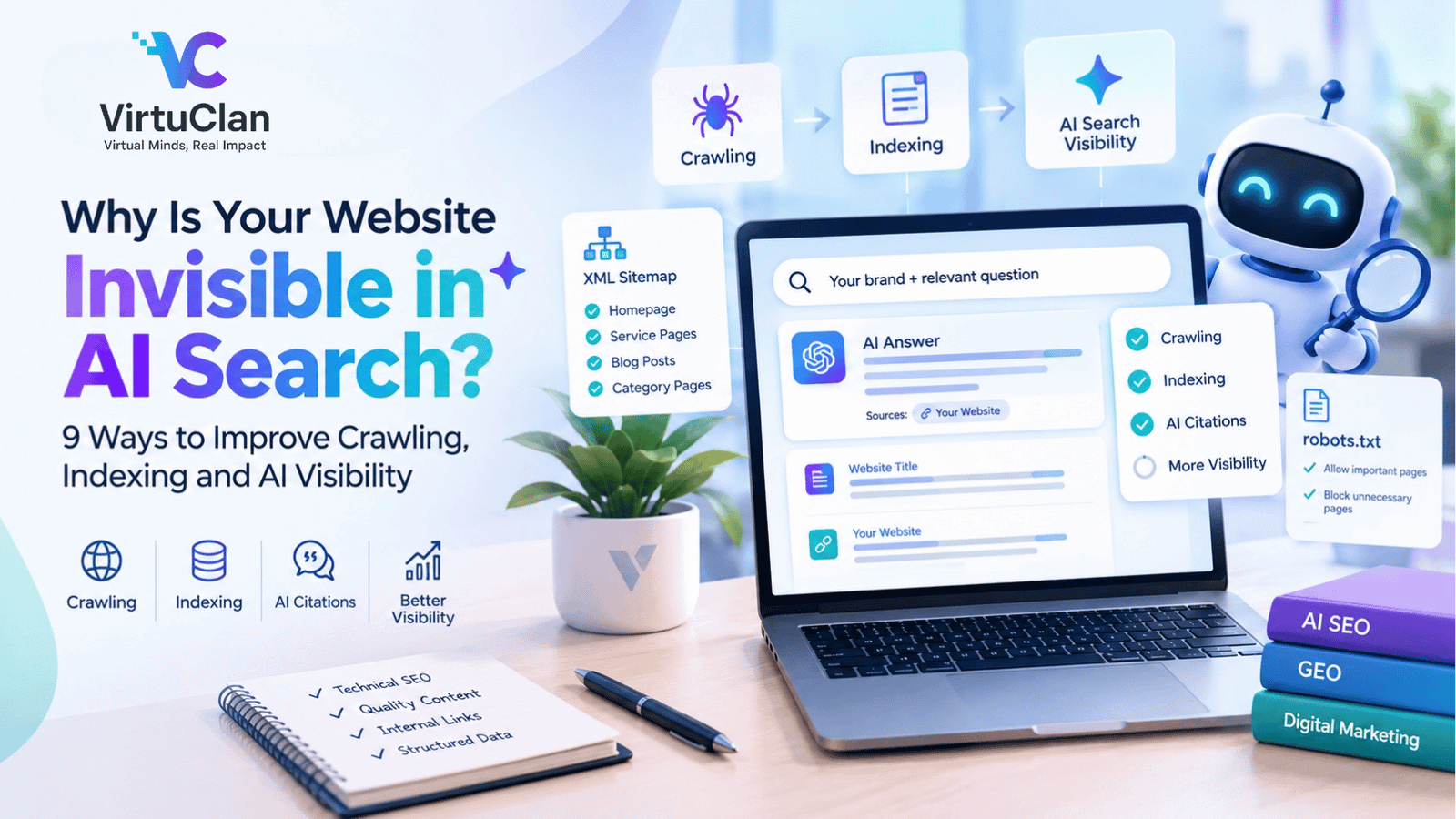
<p>Your website can have useful content, professional design, and valuable services—and still struggle to appear in search results or AI-generated answers. When that happens, the problem may not be your keywords alone. Search engines and AI-powered discovery experiences need to find your pages, crawl them, understand their content, and decide whether they are relevant enough to surface.</p>
<p><strong>AI search visibility starts with discoverability, technical accessibility, useful content, and trust.</strong> No technical fix or content formula guarantees a citation in ChatGPT, Google AI Overviews, Microsoft Copilot, or another AI platform. However, improving these foundations can make your website easier to discover and understand.</p>
<p>In this guide, VirtuClan explains nine practical ways to troubleshoot a website that is not appearing in AI search and build a stronger foundation for traditional SEO and generative engine optimization (GEO).</p>
<h2>What Does AI Search Visibility Mean?</h2>
<p>AI search visibility is the extent to which a business or its website appears, is mentioned, or is referenced as a source in AI-powered search experiences. Depending on the platform, visibility may take the form of a linked citation, a brand mention, a recommended business, or a page included in an AI-generated summary.</p>
<p>AI search visibility is different from simply ranking for a keyword. A page may receive organic impressions without being cited in a particular AI answer, and an AI platform may produce different sources for different questions. Measurement should therefore include traditional search performance, indexation, relevant referrals, and observed citations where data is available.</p>
<h2>Why Is Your Website Not Appearing in AI Search?</h2>
<p>Common reasons include pages that are not indexed, blocked crawlers, weak internal linking, missing or inaccurate sitemap entries, unclear content, duplicate pages, poor technical health, and a lack of useful evidence supporting the website's claims.</p>
<p>Before publishing more articles, diagnose whether important existing pages can be discovered and understood. More content will not solve a crawl or indexing problem on its own.</p>
<h2>1. Check Whether Your Important Pages Are Indexed</h2>
<p>Website crawling and indexing are related but different processes. Crawling means a search engine fetches a page. Indexing means it analyzes and may store the page in its search index. A crawled page is not guaranteed to be indexed, and an indexed page is not guaranteed to appear for every query.</p>
<p>Start with Google Search Console's URL Inspection tool and Bing Webmaster Tools. Inspect your homepage, core service pages, and important blog URLs. Review whether the URL is known, whether crawling was allowed, whether indexing is permitted, and whether the selected canonical URL is correct.</p>
<ul>
<li>Inspect important URLs individually.</li>
<li>Look for unexpected noindex directives.</li>
<li>Check for canonical tags pointing to a different page.</li>
<li>Review crawl errors and server response problems.</li>
<li>Fix the cause before requesting another crawl.</li>
</ul>
<p>For example, after publishing an article about AI SEO, verify that its public URL loads successfully and is not accidentally marked noindex. Requesting a crawl can help discovery, but it does not guarantee indexing or AI citations.</p>
<h2>2. Create and Maintain an XML Sitemap</h2>
<p>An XML sitemap lists important URLs that you want search engines to discover. It is particularly useful for helping search engines understand a website's URL inventory, including newly published or updated pages.</p>
<p>A useful sitemap should:</p>
<ul>
<li>Include canonical, indexable URLs that return a successful response.</li>
<li>Exclude URLs that redirect, return errors, or should not be indexed.</li>
<li>Use accurate last-modified information where supported.</li>
<li>Be updated when important content changes.</li>
<li>Be submitted through the relevant webmaster tools.</li>
</ul>
<p>For a website publishing blogs and service pages, make sure the sitemap includes the public URLs you want search engines to discover. Do not assume that creating a sitemap automatically makes every listed URL indexed.</p>
<h2>3. Review Your robots.txt File Carefully</h2>
<p>The robots.txt file provides crawler access instructions. A broad blocking rule can prevent a crawler from fetching important website content. At the same time, robots.txt is not a reliable way to remove a URL from an index by itself.</p>
<p>Check your live robots.txt file and confirm that important public pages and required resources are not unintentionally blocked. Review the rules for relevant crawlers, including Googlebot and Bingbot, and ensure that hosting or CDN settings do not introduce additional restrictions.</p>
<p>Do not copy a restrictive robots.txt template from another website without understanding its rules. The correct configuration depends on your website's structure and which pages you want discoverable.</p>
<h2>4. Make Important Content Accessible to Crawlers</h2>
<p>Search systems need to retrieve and process page content. Important information should be available in the rendered page, not only inside an image, inaccessible file, or interaction that a crawler cannot reliably process.</p>
<p>Use descriptive HTML headings, readable paragraphs, working links, and meaningful image alt text. Check that key service information is visible without requiring a user to complete a form or sign in. Test the public page on mobile devices and investigate server errors or unusually slow responses.</p>
<p>If a page relies heavily on JavaScript, verify that its primary content and links can be rendered and discovered. Keep the page useful for people as well as technically accessible to search systems.</p>
<h2>5. Write Clear, Answer-Focused Content</h2>
<p>Clear content helps readers understand a topic quickly. It can also make it easier for search systems to interpret the page's subject and identify relevant information.</p>
<p>For each important page, answer these questions near the beginning:</p>
<ul>
<li>What is the topic or service?</li>
<li>Who is it for?</li>
<li>What problem does it solve?</li>
<li>How does it work?</li>
<li>What evidence or practical details support the explanation?</li>
</ul>
<p>Use one clear H1, descriptive H2 headings, short paragraphs, and examples that add real value. Define specialist terms such as AI SEO, answer engine optimization (AEO), and generative engine optimization (GEO) instead of assuming every reader understands them.</p>
<p>Answer-focused content does not mean repeating a keyword in every paragraph. Write naturally, cover the reader's actual question, and include useful context that differentiates your page from generic summaries.</p>
<h2>6. Build Helpful Internal Links Between Related Pages</h2>
<p>Internal links help people navigate your website and help crawlers discover connected pages. They also clarify how your services and educational resources relate to one another.</p>
<p>For example, an article about AI search visibility can link to a detailed AI SEO service page, a technical SEO resource, and a relevant contact page. A service page can link back to educational content that answers common customer questions.</p>
<p>Use descriptive anchor text rather than relying exclusively on phrases such as “click here.” Check that links use the correct canonical URL, return a successful response, and are present as crawlable links in the page HTML.</p>
<p>Explore <a href="https://virtuclan.com/services">VirtuClan's services</a> to see how SEO, content strategy, and AI visibility can support a connected digital marketing approach.</p>
<h2>7. Strengthen Trust and Originality</h2>
<p>Search visibility is not just a technical challenge. Your content also needs to provide a good reason for people to trust and use it.</p>
<p>Make your business information clear. Explain your process, identify authors where appropriate, support factual claims with reliable sources, and publish examples that reflect genuine experience. If you share case studies or results, use accurate data and explain the context.</p>
<p>Avoid invented statistics, fake testimonials, fabricated credentials, and unsupported promises such as guaranteed AI citations. Publishing large volumes of near-identical articles with little original value can be counterproductive.</p>
<p>AI tools can assist research and drafting, but each article should be reviewed for accuracy, usefulness, originality, and alignment with your actual expertise.</p>
<h2>8. Use Structured Data Only When It Fits the Page</h2>
<p>Structured data provides search engines with additional context about page content. Depending on the page, relevant types may include Organization, Article, or BreadcrumbList. Local businesses may also benefit from appropriate LocalBusiness markup when it accurately represents their details.</p>
<p>Structured data must match information visible on the page and follow the relevant search platform's guidelines. Validate the markup, keep business details consistent, and remove properties that are inaccurate or no longer applicable.</p>
<p>Schema markup is not a shortcut to AI citations. There is no special schema type that guarantees a page will be selected by an AI assistant.</p>
<h2>9. Measure Search and AI Visibility Separately</h2>
<p>Use a baseline so you can distinguish a real improvement from a one-off result. Review traditional search metrics alongside available AI visibility data.</p>
<ul>
<li><strong>Indexing:</strong> Are important pages eligible and present in search indexes?</li>
<li><strong>Organic performance:</strong> Are impressions, clicks, and relevant queries changing?</li>
<li><strong>Crawl health:</strong> Are important pages accessible without errors?</li>
<li><strong>AI citations:</strong> Does a supported reporting tool show your URLs as cited sources?</li>
<li><strong>Qualified traffic:</strong> Are relevant visitors reaching service pages and converting?</li>
</ul>
<p>Bing Webmaster Tools includes AI Performance reporting for supported experiences, showing citation activity and grounding-query insights where available. Use these reports to identify which pages and topics are being referenced. The data represents the platform's available reporting and should not be treated as a complete view of every AI interaction.</p>
<p>When manually checking an AI platform, record the exact prompt, platform, date, brand mention, and source URL. Repeat the same checks over time because answers and sources can vary.</p>
<h2>A Practical AI Search Visibility Checklist</h2>
<ul>
<li>Important URLs return a successful response.</li>
<li>Pages intended for discovery are not blocked or marked noindex.</li>
<li>The XML sitemap lists current canonical URLs.</li>
<li>Robots.txt rules allow the intended crawlers to access public content.</li>
<li>Important pages are linked from relevant pages on the website.</li>
<li>Page titles, headings, and main content clearly match the topic.</li>
<li>Content includes useful, accurate information beyond generic summaries.</li>
<li>Structured data, where used, matches the visible page.</li>
<li>Google Search Console and Bing Webmaster Tools are monitored.</li>
<li>Search performance, AI citations, and business conversions are measured separately.</li>
</ul>
<h2>How VirtuClan Can Help Improve AI Search Visibility</h2>
<p>At VirtuClan, we focus on the foundations that help businesses build a stronger digital presence: technical SEO, useful content, connected service pages, local search optimization, and AI visibility strategy.</p>
<p>Every website has a different set of challenges. A useful first step is to identify whether the main barrier is crawling, indexing, content quality, site structure, or a lack of relevant information for the intended audience. The right priorities should come from an audit rather than a one-size-fits-all checklist.</p>
<p>Explore <a href="https://virtuclan.com/services">our services</a>, learn about <a href="https://virtuclan.com/services/local-seo">local SEO</a>, or <a href="https://virtuclan.com/contact">contact VirtuClan</a> to discuss your website's search visibility goals.</p>
<h2>Frequently Asked Questions</h2>
<h3>Why is my website not showing up in ChatGPT or other AI search tools?</h3>
<p>Possible reasons include limited discoverability, indexing issues, inaccessible content, weak topical relevance, or the platform not selecting your page for that particular question. First check whether the page is publicly accessible and indexed where applicable. No single fix guarantees inclusion.</p>
<h3>Does an XML sitemap help with AI search visibility?</h3>
<p>A sitemap can help search engines discover important URLs and understand site coverage. It does not guarantee crawling, indexing, rankings, or AI citations. Keep the sitemap accurate and submit it through supported webmaster tools.</p>
<h3>Does robots.txt control whether a page is indexed?</h3>
<p>Robots.txt primarily controls crawler access. It is not a dependable way to prevent a URL from appearing in an index. If a page should not be indexed, use the appropriate supported noindex mechanism and make sure the crawler can access the page to read that directive.</p>
<h3>Do I need an llms.txt file for ChatGPT or Google AI search?</h3>
<p>Do not treat llms.txt as a required shortcut to AI visibility. Google's published guidance says that new AI text files are not required for its AI search features. Prioritize crawlability, indexable pages, useful content, internal links, and reliable site information.</p>
<h3>How long does it take for a new blog to be indexed?</h3>
<p>There is no fixed timeline. Discovery and indexing depend on the website, the page, crawl access, and search-system decisions. Use URL inspection and sitemap submission where appropriate, then monitor status rather than repeatedly submitting the same URL.</p>
<h3>Can SEO guarantee citations in AI-generated answers?</h3>
<p>No. SEO and content improvements can support discoverability and relevance, but AI platforms choose sources using their own systems and may produce different answers for different prompts. Measure visibility over time and focus on useful content that serves your audience.</p>
<h2>Final Thoughts</h2>
<p>If your website is not appearing in AI search, start by checking the foundations instead of publishing more content blindly. Make important pages accessible, improve indexing signals, connect related resources, and create original content that answers genuine questions.</p>
<p><strong>Better AI search visibility begins with a website that can be discovered, understood, and trusted.</strong> Build those foundations consistently, monitor the results, and refine your strategy as search experiences evolve.</p>